
How AI is Revolutionizing Jingle Creation for Brands

by | Jan 1, 2026 | AI in Jingles

AI Jingle Creation for Businesses: How Artificial Intelligence Transforms Audio Branding and Sonic Marketing

AI-driven jingle creation uses machine learning models to generate melodies, harmonic arrangements, and synthesized vocals that align with a brand’s identity, enabling faster production and consistent sonic assets. This article explains what AI jingle creation is, how generative AI music and AI voiceover tools work, and why marketing teams should consider AI audio branding for scale, rapid iteration, and measurable performance gains. Readers will learn about service types (fully generative, template-based, and human-in-the-loop), leading platform capabilities, practical integration steps across channels, and the legal and ethical considerations relevant to commercial use. The guide also examines emerging trends such as adaptive music and procedural audio, compares tools by output quality and licensing, and provides implementation templates and KPI recommendations for testing jingles in campaigns. By the end, marketing leaders and creative directors will have a tactical roadmap for piloting AI-generated jingles while preserving brand distinctiveness and managing rights.

What is AI-driven jingle creation, and how does it benefit businesses?

AI-driven jingle creation is the automated process of composing short, brand-aligned musical motifs using generative algorithms that output melody, harmony, and production stems tailored to a specified style. These systems work by mapping brand attributes to musical features—tempo, timbre, melodic contour—and then producing variants that accelerate ideation and reduce per-asset cost. The key business benefits include faster time-to-audio, lower marginal costs for variations, and easier A/B testing of sonic options, which together improve campaign agility and ROI. Understanding these benefits clarifies when to use fully automated generation versus hybrid workflows that preserve creative control, which we explore next in service-type detail.

Indeed, the historical evolution of jingles highlights their importance in branding, a role now enhanced by AI’s ability to optimize ad performance through automated creation and testing.

AI for Jingle Creation & Ad Performance Optimization

As the 19th century progressed, along came catchy jingles, which were short, memorable tunes or phrases used in advertising to promote a product or service. These jingles were designed to stick in people’s minds, creating a strong association between the tune and the brand. The implementation of an independent AI driven creative optimization engine can help to automate the process of creating and testing different ad variations, allowing marketers to quickly identify the most effective ads and optimize their campaigns for better performance.

Creative AI: a data-driven design approach for creative online ad optimisation using artificial intelligence and big data, H Phay, 2019

AI music composition services fit different campaign sizes and risk profiles; the following subsection explains those service types and recommended use cases.

Understanding AI music composition services for marketing
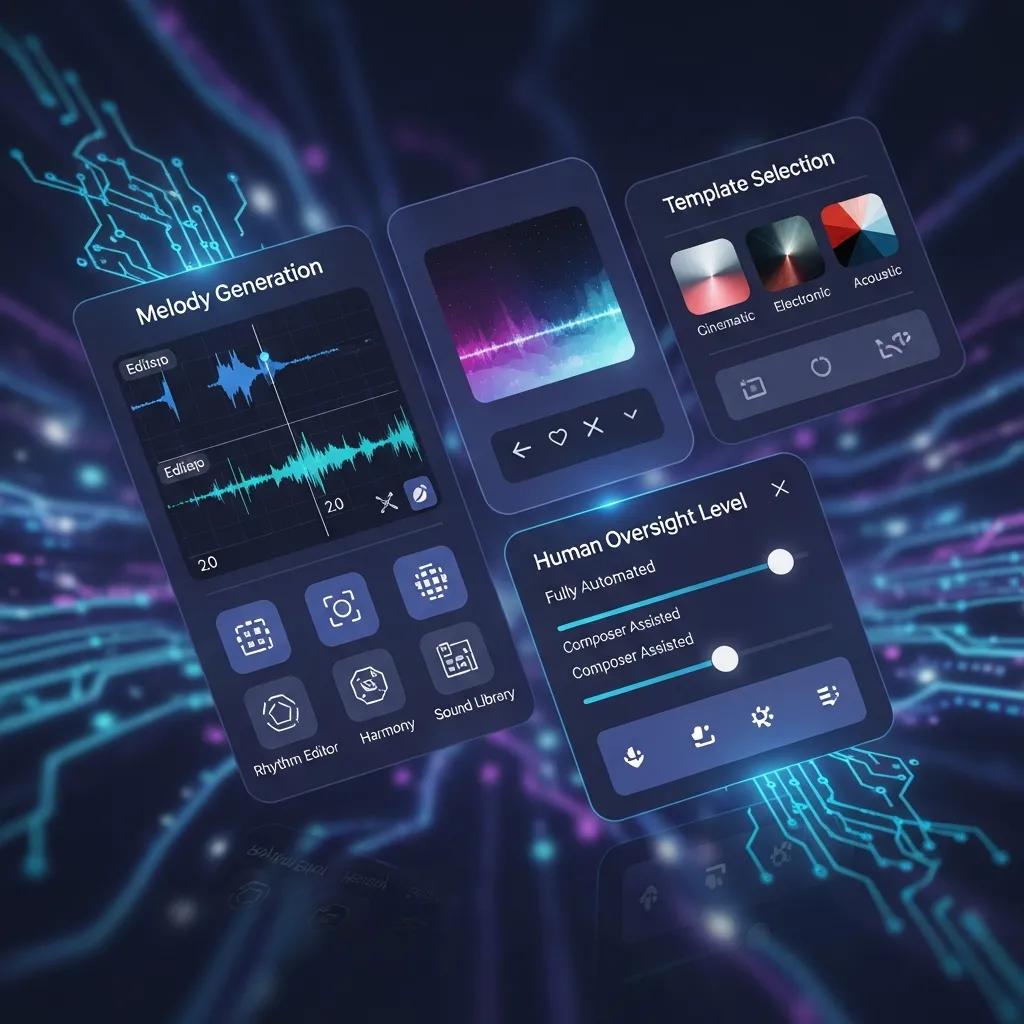
AI music composition services fall into three main types: fully generative engines that produce original tracks from prompts, template-based platforms that assemble music from predesigned motifs, and human-in-the-loop services that combine AI drafts with professional sound design. Fully generative services excel when you need many variations quickly, such as for programmatic audio ads. At the same time, template systems work well for consistent IVR or hold music where brand guidelines must be enforced. Human-in-the-loop workflows are ideal for flagship campaigns or sonic logos where nuance and legal clarity matter; they preserve brand voice while leveraging AI speed. Choosing the exemplary service depends on campaign risk tolerance, budget, and the required level of uniqueness.

These service types set the stage for the specific advantages generative AI brings to audio branding and how those advantages translate into measurable outcomes.

Advantages of generative AI music in audio branding

Generative AI music delivers three operational advantages that matter to marketing teams: rapid iteration, scalable variation, and lower unit costs for additional assets.

Rapid iteration lets creative teams test multiple melodic hooks within hours rather than days, shortening the creative feedback loop and enabling more effective A/B testing.

Scalable variation supports localization and personalization—different mixes or stems for regions, ad lengths, or platforms—without linear increases in production budgets.

Together, these advantages increase the cadence of testing and optimization, enabling brands to iterate on sonic identity with data rather than intuition.

These practical advantages leadtoo how AI reshapes the strategic landscape of sonic branding and the expectations brands should set for future workflows.

How does artificial intelligence shape the future of sonic branding?

Artificial intelligence is changing sonic branding by enabling adaptive audio, real-time personalization, and production workflows that blend automated composition with human oversight to protect brand identity. As AI systems improve in realism and control, brands can expect more dynamic audio that adjusts to context—listener profile, device, or content—so sonic assets become responsive components of the customer experience. This shift redefines brand identity from static audio logos to flexible sonic systems that scale across touchpoints while retaining recognizability. The following subsections detail the main technological trends and the accompanying shifts in customer engagement expectations.

Understanding these trends clarifies the specific technologies marketers should watch and pilot in 2024 and beyond.

Emerging trends in AI audio branding technologies

Current research and product roadmaps indicate three major trends: adaptive audio that tailors music in real time, procedural music engines that generate content algorithmically for dynamic contexts, and leaps in voice synthesis that offer more expressive AI voiceovers. Adaptive audio systems connect user data to musical parameters—changing instrumentation or tempo to increase relevance—while procedural engines create near-infinite content for games, streaming ads, or interactive ads. Advances in voice synthesis add nuance and emotional control, enabling branded voice personalities with consistent delivery across channels. These technologies are increasingly production-ready for pilots, though governance and testing remain crucial before broad deployment.

The rapid advancements in AI for commercial audio, from early neural network processing to modern text-to-speech capabilities, underscore these emerging trends.

AI in Commercial Audio: Evolution, Processing, and Text-to-Speech

The paper covers the emergence and evolution of AI in the commercial field of audio: from the pioneering German audio software company Prosoniq Products Software, which first used artificial neural networks for commercial audio processing, creating in 1997 the program Pandora Music Decomposition Series that managed to separate music into its components, to the indispensable technologies for sound processing involving machine learning (iZotope and Audionamix ADX Trax Pro 3), to the spleeter technology, ChatGPT from OpenAI that applies AI technology also to the area of sound processing, to Adobe or ElevenLabs that offers online AI services with Text to Speech and Speech to Speech functions.

The Impact of AI in the Field of Sound for Picture. A Historical, Practical, and Ethical Consideration, DȘ Rucăreanu, 2024

With the identified technological trend, the following section examines how these capabilities influence brand recall and customer engagement metrics.

Impact of AI on brand identity and customer engagement
AI-driven audio has measurable effects on brand recognition, recall, and engagement by enabling consistent exposure to optimized sonic cues and by supporting personalized experiences that increase relevance. Brands that test short melodic hooks across populations can quantify recognition lift and correlate audio variants to CTR and completion rates, improving creative decisions with empirical evidence. Measuring these effects requires audio-specific metrics—completion rate, recall percentage, and audio-driven CTR lift—paired with qualitative brand-fit assessments from focus groups and brand-lift studies. Combining these quantitative and qualitative measures ensures that adaptive or personalized audio enhances recognition without diluting core brand associations.

These measurement approaches naturally lead to the question of which tools and platforms can produce the needed assets and metadata, which we cover next.

Which AI tools and platforms are leading in jingle creation?

A practical survey of leading AI jingle tools categorizes platforms by output type (entirely generated tracks, stem exports, voice synthesis), licensing clarity, and integration capabilities for marketing pipelines. Tools vary in their emphasis on style control, stems export for mixing, and commercial licensing terms—factors that determine whether a brand can use outputs in paid media at scale. Comparing features helps marketing teams choose between off-the-shelf generative outputs, hybrid human+AI workflows, or commissioning bespoke audio with AI-assisted composition. The table below summarizes representative tool characteristics to speed up evaluation.

Below is a compact comparison of representative platforms to evaluate by output quality, licensing, and typical use case.

ToolOutput Quality & FeaturesLicensing & Commercial UseTypical Use Case
Generative engine (prototype)Fast melodic variants; style prompts; limited stemsRoyalty-free, but check commercial terms per trackProgrammatic audio ads, quick concepting
Template-based platformPrebuilt motifs, consistent brand templates, and stem exportClear commercial license tiers for campaignsIVR, hold music, standardized ads
Human-assisted serviceAI drafts + pro mixing; custom voice synthesis moduleCustom licensing; recommended for flagship assetsSonic logo, broadcast spots, brand campaigns

This table clarifies trade-offs between speed, control, and licensing complexity; the following subsection lists top service strengths and scenarios to guide selection.

Top AI music composition services for businesses

Leading services fall into three profiles: rapid-iteration generators, enterprise template suites, and boutique human-assisted studios that embed AI into creative workflows. Rapid-iteration generators produce dozens of short motifs appropriate for programmatic campaigns and social clips where speed matters more than unique ownership. Enterprise template suites trade some uniqueness for repeatability and compliance, making them practical for IVR, on-hold music, and large-scale deployments. Boutique services combine AI prototypes with composer oversight to create unique sonic logos and broadcast-ready jingles where IP clarity and artistic nuance are non-negotiable.

Comparing these profiles helps determine whether a brand needs speed, consistency, or premium uniqueness for its audio goals.

Comparing features of popular generative AI music solutions

Feature comparison should weigh style controls, stems export, tempo and key control, voice synthesis fidelity, and licensing granularity to ensure outputs meet production and legal requirements. Brands that need post-production flexibility should prioritize platforms that deliver separated stems and WAV exports; those focused on safe commercial use must verify explicit commercial licenses and metadata for rights tracking. In practice, a hybrid workflow—AI draft + human mixing—often balances cost with the need for a unique brand voice. The EAV-style comparison below distills key feature differences for quick decision-making.

Platform CategoryFeature StrengthBest-fit Scenario
Rapid generatorStyle prompt variety; low cost per variantLarge A/B test campaigns
Template suiteConsistency; metadata & license clarityIVR and global deployments
Human-assistedCustomization; voice synthesis controlFlagship campaigns and sonic logos

This comparison shows that combining tools often yields the best results: automation for scale plus human oversight for signature pieces. The following section explains how to operationalize AI jingles across channels.

How can businesses integrate AI-generated jingles into their marketing strategies?

Integrating AI-generated jingles requires a transparent process from creative brief through deployment, channel-specific adaptation, and measurement to ensure brand consistency and performance. A concise implementation pathway helps operations align stakeholders—creative director, AI operator, legal—and set timelines for prototyping, A/B testing, and scaled rollout. Choosing the right deployment model depends on campaign goals: rapid creative testing favors iterative generators, while omnichannel campaigns require strict sonic guidelines and stem-level control. The practical templates below map everyday use cases to responsible parties and timelines to accelerate adoption.

Use CaseImplementation StepsResponsible Party & Timeline
Paid social ad jinglesBrief → AI draft variants → A/B test → Select winning mix → Finalize stemsCreative + AI operator, 2–3 weeks
IVR/hold musicBrand brief → Template selection → Compliance check → DeployOps + Legal, 1–2 weeks
Podcast stings & introsPrompt generation → Human polish → Delivery in required formatsSound designer + Producer, 1–2 weeks

These templates give practical starting points for pilots and explain who owns each step and how long initial deliveries typically take.

Best practices for using AI audio branding in campaigns

Adopt a brand-first checklist to preserve identity: define a sonic brief, codify instrument and tempo constraints, require stems for reuse, and enforce human review gates before paid deployment. Establish review checkpoints—AI concept review, legal clearance, and final mastering—to ensure quality and rights compliance across territories. Maintain a living brand-audio guideline that documents voice timbre, logo variants, permissible adaptive rules, and testing thresholds for new variants. These steps keep automation from eroding distinctiveness and ensure AI supports, rather than replaces, creative intent.

  • Brand Briefing: Create a one-page sonic brief that maps brand attributes to musical features.
  • Quality Gates: Require human review and mastering for any asset used in paid media.
  • Rights Checklist: Ensure licensing metadata and commercial terms are captured before deployment.

This checklist helps teams operationalize quality control while leveraging AI to improve speed and reduce variation.

Measuring the effectiveness of AI-created jingles in marketing

Measurement should combine audio-specific KPIs with standard campaign metrics to capture both recognition and performance impact. Recommended KPIs include audio recall (survey-based), CTR lift for ads with vs without the jingle, completion and listen-through rates for audio-first channels, and downstream conversion lift when applicable. Design A/B tests with proper sample sizes and holdout groups to isolate audio effects, and use audio analytics—completion rates and engagement heatmaps—to refine mixes. A cadence of rapid tests followed by scaled rollouts lets teams iterate on musical hooks with empirical confidence.

  • Suggested KPIs:

    Audio Recall: Percentage of users recognizing the jingle in brand-lift studies.
    CTR Lift: Relative increase in click-throughs for ads using the jingle.
    Completion Rate: Percent of audio spots listened to through to the end.

These measurement steps create a feedback loop where creative choices are validated by data and then scaled confidently.

What challenges and ethical considerations arise with AI in audio branding?

AI audio creation raises four core challenges: copyright and ownership ambiguity, potential imitation of existing voices or styles, variability in quality control, and bias or contextual mismatch in automated personalization. Addressing these requires clear rights-management practices, human-audited style controls, and operational policies that define when to use AI versus commissioning human composers. Legal clarity about who owns generated audio and how licensing metadata is recorded is essential before commercial deployment. The following risk table converts common concerns into actionable impact assessments.

These challenges are further complicated by broader ethical considerations in audiovisual production, particularly concerning data privacy and the responsible use of AI.

Ethical AI in Audiovisual Production: Data, Rights, and Global Principles

However, in recent years the development of AI has faced serious difficulties due to the use of personal data without authorization or due to facial superimposition and other unilateral actions on the part of the production companies, following the complaints of the affected unions. Based on the above, a review is made of the contributions on ethics of artificial intelligence worldwide in recent years, including the values and principles recommended by the Organization for Economic Co-operation and Development (OECD) (2019), Naciones Unidas (2021), UNESCO (2022), and the World Economic Forum (2024).

Ethical Considerations in the Use of Artificial Intelligence in the Audiovisual Field, RI Arévalo-Martínez, 2025

RiskImpactLikelihoodRecommended Mitigation
Copyright ambiguityHighMediumRetain detailed licensing records; prefer platforms with explicit commercial terms.
Voice imitationHighMediumAvoid models trained on specific artists; require human oversight for voice likeness
Quality inconsistencyMediumHighImplement human QA and final mastering gates
Contextual mismatchMediumMediumUse segment rules and testing to validate personalization logic

This risk-oriented approach supports decisions about when to escalate to legal counsel and when to favor human-led production.

After reviewing licensing and ownership concerns, schedule a free consultation to review licensing, rights management, and how to combine human oversight with AI.

Addressing originality and copyright in AI music creation

Originality and copyright questions hinge on training data, derivation, and licensing terms; brands must verify whether an AI output is legally safe for commercial use. Practical checks include requesting provenance or training-data disclosures where available, using platforms that attach machine-readable license metadata, and documenting brief-to-output links in project records. When uniqueness is critical, favor human-assisted workflows that start from original musical sketches to ensure defensible ownership. If ambiguity remains, engage legal counsel before high-risk deployments; this due diligence protects brands from downstream claims and preserves reputational integrity.

These licensing checks inform the operational balance between automated scale and controlled human authorship, explored next.

Balancing automation with human creativity in sonic branding

A hybrid workflow preserves brand identity by combiningAI’ss speed with human expressive control: AI generates concept variants, sound designers select and refine, and creative directors sign off on final masters. Define roles clearly—creative director sets sonic brief, AI operator generates variants and metadata, and sound designer polishes selected stems—so accountability and quality are maintained. Human review gates should focus on brand fit, emotional nuance, and legal safety rather than elemental composition, leveraging AI for ideation and humans for signature decisions. This balance unlocks scale while ensuring the brand’s core musical identity remains coherent.

Establishing these role definitions and gates lets teams scale experimentation without sacrificing artistic standards.

How will AI continue to evolve in the field of jingle creation and audio branding?

AI will likely deliver greater expressivity, tighter integration with personalization systems, and improved metadata for rights tracking, enabling dynamic jingles that adapt to listener context while remaining legally auditable. Expect incremental improvements in melody naturalness, voice synthesis articulation subtleties, and multi-track export fidelity, reducing the human work required for final masters. Deeper integration between audio engines and customer data platforms will enable context-aware sonic variations that vary by region, moment in the customer journey, or device. These advances will shift the balance of in-house vs agency workflows as tools make basic production more accessible and strategic audio design becomes the differentiator.

The following subsections forecast specific technical advances and promising application pilots marketers can try.

Predictions for future advancements in AI music composition

Near-term advancements will focus on expressive control—dynamics, micro-timing, and emotion modulation—so generated jingles will convey more nuanced brand personalities. Models will expose richer parameter sets (articulation, vibrato, timbral morphing), enabling sound designers to sculpt AI outputs with composer-like precision. Expect better integration of stems and metadata that support rights management and post-production workflows. As these capabilities mature, brands will rely less on raw synthesis for flagship assets and more on AI-assisted compositing, reducing costs while preserving bespoke quality.

These technical improvements set the stage for novel marketing applications that capitalize on scale and context-awareness.

Potential new applications of AI in marketing sound design

New applications include dynamic streaming jingles that adapt per listener, contextual IVR music that reflects wait times or caller value, and personalized podcast stings that insert regional or user-specific references. Brands can pilot interactive ad formats in which music shifts in real time based on user responses or ad length, and test adaptive hold music that adjusts tempo to reduce perceived wait time. Quick experiments—small-scale A/B tests or geolimited pilots—are ideal for validating these concepts before broader rollouts, focusing on measurable outcomes such as recall lift and engagement.

Brands that pilot these scenarios early will learn how to govern personalized audio without compromising identity, preparing them for wider adoption as technology and legal frameworks evolve.