

Measure Jingle Effectiveness for Maximum Marketing ROI

by | Dec 31, 2025 | Advertising

How to Measure the Effectiveness of Your Jingle: A Comprehensive Guide to Jingle ROI and Audio Advertising Analytics

A jingle’s effectiveness is the measurable impact a short musical asset has on brand recognition, audience engagement, and revenue outcomes, and measuring that effectiveness is essential for marketing ROI and long-term sonic-brand strategy. This guide explains how to define jingle effectiveness, which metrics matter, the tools and research methods available, and the practical steps for calculating attributable revenue from audio campaigns. Marketers and audio brands often struggle to translate memorable melodies into measurable outcomes; this article offers a clear framework—from brand-lift studies and surveys to audio analytics and incrementality testing—to quantify impact. You will learn core KPIs such as brand recall and engagement, how to select the right measurement platforms, a repeatable ROI formula with an example, and approaches to iterative A/B testing and audio optimization. Each H2 section breaks down actionable methods and includes comparison tables and checklists you can apply to radio, podcast, and streaming campaigns. Read on to convert sonic creativity into reliable, data-driven decisions that support budget allocation and creative refinement.

The inherent power of music in marketing, often referred to as sonic branding, has long been recognized for its direct impact on consumers, despite being an evolving field.

Sonic Branding: Consumer Impact & Marketing Potential

Because music holds a strong power over people, and its impact on consumers is relatively direct, it is invariably an interesting medium for marketers. Although Sonic Branding – branding with music and sound – has been seen as ‘the next big thing’ in branding toward consumers for about a decade, it is a scattered field still waiting for its breakthrough.

Sonic branding: A consumer-oriented literature review, C Gustafsson, 2015

What Are the Key Metrics to Measure Jingle Performance?
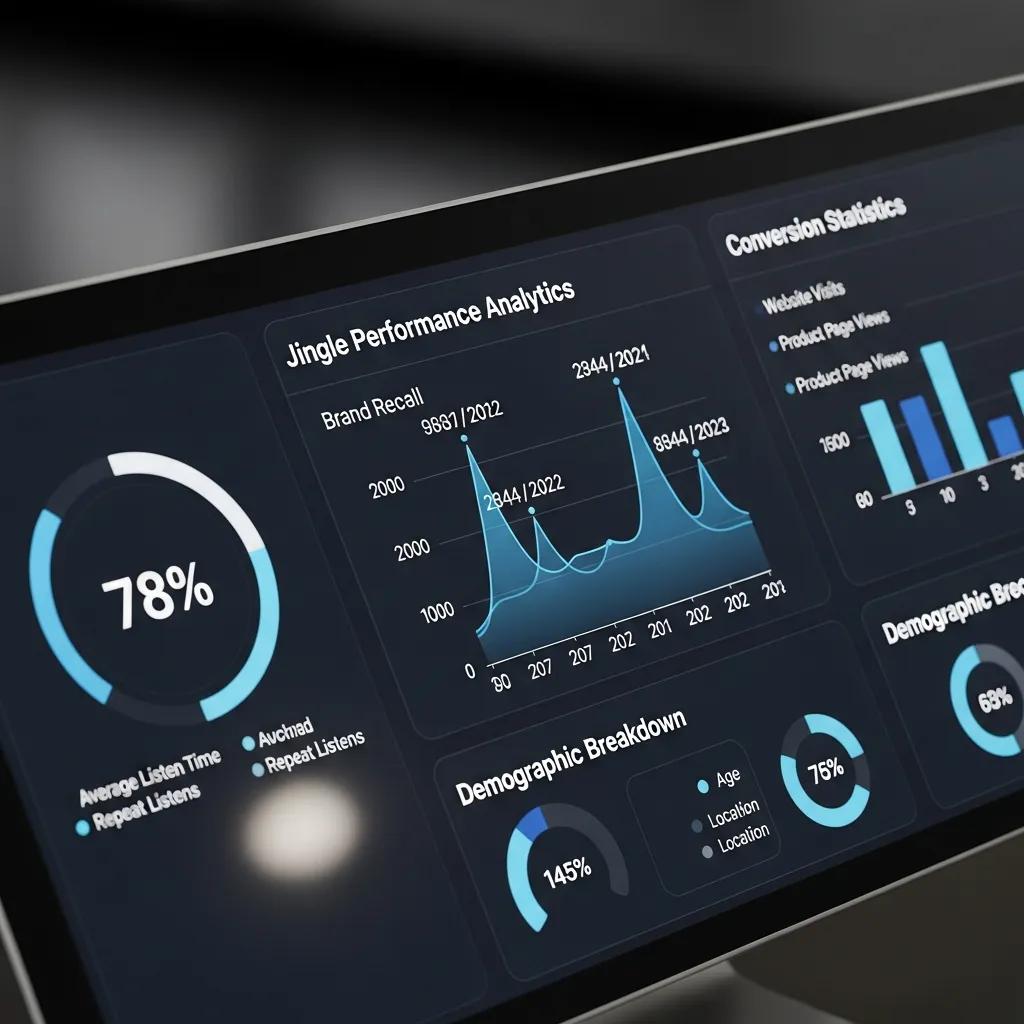
Jingle performance is typically evaluated by a set of complementary metrics that together show memorability, brand linkage, and commercial impact. These metrics work because they map auditory exposure to cognitive responses (recall/recognition), behavioral engagement (clicks, visits, completions), and conversion outcomes (promo redemptions, sales lift). Measuring these indicators regularly helps teams detect creative fatigue, optimize placement, and attribute value to sonic branding investments. Below is a concise table that defines each key metric and explains how it is typically measured in practice.

MetricMeasurement MethodRecommended Frequency
Brand RecallPercent unaided/aided recall in post-exposure surveysAfter major campaign waves or monthly for active campaigns
Brand RecognitionLogo-jingle association in aided tests or recognition panelsQuarterly or after creative changes
Audience EngagementAudio completion rates, social shares, website session lift with UTM tagsOngoing via platform analytics weekly/monthly
Conversion RateLanding page conversions tied to audio placements or promo codesPer campaign and aggregated monthly
Memorability IndexRepeat listen counts, ad recall rates, qualitative scoringPost-campaign and during testing phases

These metrics create a balanced measurement set that captures immediate reactions and downstream results, and together they guide decisions about creative iteration, platform mix, and spend reallocation. Understanding measurement cadence and sample-size guidance supports statistical confidence, which in turn informs how recall and recognition are tested in detail.

How Do Brand Recall and Recognition Reflect Jingle Success?

Brand recall and recognition are distinct but related indicators of jingle memorability and brand association. Unaided recall measures how many respondents spontaneously name the brand or jingle after exposure, while aided recognition tests whether listeners identify the jingle or brand when prompted; both reflect different depths of memory encoding and brand linkage. A strong jingle will raise unaided recall in shorter exposure windows and will strengthen recognition across time, indicating durable sonic branding. Recommended testing formats include short online surveys with control cohorts and split-sample aided/unaided questions to isolate jingle effects from other campaign elements and to provide statistically meaningful lift estimates.

Measuring recall properly requires calibrated questions and representative samples to avoid bias and ensure reliable estimates of jingle effectiveness. Typical sample sizes depend on expected lift and desired confidence intervals, but even small controlled studies can identify directional improvements that warrant creative tweaks. Interpreting results should consider baseline brand awareness so that recall lift is measured relative to starting awareness; this perspective leads to assessing engagement signals that bridge cognitive responses and behavioral outcomes.

What Role Does Audience Engagement Play in Measuring Impact?

Audience engagement turns awareness into measurable behavior that is traceable in digital environments, and it is an essential bridge between audio impressions and conversions. Engagement signals include audio completion rates, click-throughs from companion ads, website session increases with UTM tracking, social mentions, and direct responses to promo codes delivered via the jingle. Each signal provides a partial attribution path: completion rates indicate creative resonance, UTM-driven traffic shows cross-channel activation, and promo redemptions tie directly to transactions.

Tracking engagement requires consistent tagging and analytics integration so that audio exposures can be linked to web and CRM events; this integration reduces ambiguity and supports incrementality tests. Using engagement metrics alongside recall measures provides a fuller picture: a jingle with high recall but low engagement may be memorable yet not motivating action, suggesting creative or call-to-action adjustments. Connecting these insights to platform-level analytics naturally leads to comparing the specific tools and research methods available for measurement.

Which Tools and Methods Are Best for Measuring Jingle Effectiveness?

Selecting the right mix of tools and methods depends on campaign goals, channels (radio, podcast, streaming), and budget; combining survey research with platform analytics and brand-lift studies produces the most reliable view. Qualitative methods (focus groups, in-depth interviews) uncover emotional response and association, while quantitative tools (audio ad platforms, DSP reporting, streaming analytics) provide scalable metrics for reach, frequency, completion, and click-throughs. Below is a comparative table of standard tools and what they measure, so you can map capabilities to your measurement plan.

Tool / PlatformTracksStrengths / Limitations
Streaming platform analyticsImpressions, completion, skip rates, listener demographicsStrength: granular completion data; Limitation: cross-platform attribution gaps
Podcast ad serversDownloads, ad impressions, host-read vs produced ad differentiationStrength: audience targeting; Limitation: delayed measurement and inconsistent reporting standards
Brand lift study providersAwareness, ad recall, and consideration lift via controlled surveysStrength: causality estimation; Limitation: cost and required sample sizes
Radio tracking servicesReach, frequency, estimated audience impressionsStrength: established breadth; Limitation: weaker digital attribution linkage

Choosing methods depends on whether you prioritize causal inference or scalable reporting: brand lift yields stronger causal claims, while platform analytics enable continuous optimization. The following subsections unpack how to use qualitative research and platform analytics effectively, including recommended question sets and attribution strategies.

How Can Surveys and Focus Groups Provide Qualitative Feedback?

Surveys and focus groups reveal emotional associations, lyrical clarity, and whether a jingle links to the intended brand identity—insights that raw metrics cannot fully capture. Well-designed surveys should combine unaided and aided recall questions, semantic-association scales (e.g., trustworthiness, modernity), and behavioral intent measures to quantify subjective response. Focus groups provide richer context: participants explain why a hook stands out, whether lyrics are explicit, and what feelings the melody evokes, which helps inform production or lyrical edits.

When running panels, aim for diverse representation of your target audience and use standardized prompts to compare variants meaningfully. Combine qualitative findings with quantitative indicators—such as completion rates and conversion lifts—to prioritize fixes that both increase engagement and strengthen brand linkage. Interpreting qualitative feedback alongside analyticsenables evaluation of digital analytics and platform-specific metrics that track jingle performance at scale.

What Digital Analytics and Audio Ad Platforms Track Jingle Performance?

Digital analytics and audio ad platforms provide the measurement backbone for tracking exposures, link clicks, landing-page behavior, and conversions tied to audio campaigns. Streaming platforms typically report completion rates, listener demographics, and skip behavior, while podcast hosts and ad servers provide impression counts and sometimes conversion pixels. Attribution limitations arise because audio often lacks direct click-throughs; mitigation strategies include promo codes, dedicated landing pages, and UTM parameters to bridge audio to web-based conversion tracking.

  1. Implement unique promo codes or vanity URLs to create a direct conversion path from audio to sales.
  2. Use UTM-tagged companion links and landing pages to capture visiting behavior in web analytics.
  3. Instrument audio ad servers with post-impression tracking where available, and align timestamps across systems for triangulation.

These practical steps reduce ambiguity between exposure and action and set up experiments that can isolate jingle contribution, which prepares us to calculate ROI using attributable revenue and cost components.

How Do You Calculate the ROI of Your Marketing Jingle?

Calculating jingle ROI requires an explicit formula, defensible revenue attribution to the jingle, and transparent cost accounting; the standard formula is (Revenue attributable − Cost) / cost. Attributable revenue can come from direct measures (promo code redemptions, landing-page conversions) and from modeled estimates (brand lift applied to baseline sales) when direct linkage is impractical. Below is an EAV-style table that outlines typical campaign accounting rows you can use to build a simple ROI calculation spreadsheet.

Campaign ElementAttributeValue / Example
Production CostOne-time creative & recording$X (production)
Media SpendPlacement costs across platforms$Y per campaign wave
Tracked RevenuePromo codes, landing conversions$Z via UTM/promo
Modeled LiftBrand lift estimated revenue$L = baseline sales × lift%

Start by attributing revenue conservatively using direct measures, then layer modeled lifts for longer-term brand effects. For many audio campaigns, using a hybrid approach—direct redemptions for immediate ROI and brand-lift estimates for medium-term impact—produces defensible numbers for stakeholders. Below, the formula and a brief numeric example demonstrate the calculation in practice.

For a deeper dive into established methodologies for calculating marketing ROI and optimizing media mix, consider the insights from industry leaders.

Marketing ROI Calculation & Media Mix Selection

This paper tries to convey the reader an innovative way developed by ZenithOptimedia Group, an eminent marketing ROI agency having big Italian companies such as Ferrero as their customers, in the areas of budgeting and media mix selection for advertising. Another modern approach used by Ferrero in brand communication strategies is also provided to support the importance of adapting the unsteady environment. The classical and state of the art ROI calculation techniques are covered by the inclusion of the findings in literature and the methods of ZenithOptimedia once more.

Evaluation of budgeting, channel mix selection and ROI calculation methodologies in modern market conditions, 2011

What Is the Formula for Calculating Jingle Marketing ROI?

Use a clear, replicable formula: ROI = (Revenue attributable − Total cost) /Cost. DefineCostal cost to include production, voice talent, recording, and media placement; define attributable revenue as direct sales from promo codes plus modeled incremental sales from brand lift studies. For example, if production and media total $20,000 and tracked revenue from promo codes is $35,000 with a modeled lift adding $5,000 in incremental sales, then ROI = ($40,000 − $20,000) / $20,000 = 1.0 or 100%.

Document assumptions, confidence intervals, and whether the modeled lift is included so stakeholders understand the certainty of estimates. This leads to common attribution challenges and practical mitigation tactics that improve ROI accuracy over time.

After outlining the calculation components and examples, if you want help applying this formula to your specific campaign data, consider a brief expert review—many teams find a short consultation useful for aligning attribution rules with available telemetry. For tailored assistance, contact Cary Reich, The Jingle Writer, who offers consultation to review ROI calculations and measurement plans. This practical support complements your internal analytics and helps translate audio metrics into marketing decisions.

What Challenges Arise When Quantifying Jingle Impact?

Quantifying jingle impact faces several recurring challenges: cross-channel attribution ambiguity, time-lagged brand effects, and confounding variables like concurrent promotions or creative changes. Cross-channel influence means a listener may hear a jingle on the radio but convert later after seeing a display ad, complicating immediate attribution. Time-lagged effects require longitudinal measurement—brand lift may accrue over weeks or months—so short campaign windows can understate long-term value.

Mitigation strategies include control groups or geo-split tests, dedicated promo codes for audio placements, and brand-lift studies with exposed vs control panels to estimate incremental effects. Combining these tactics with consistent tagging and conservative modeling practices reduces over-attribution. It improves the credibility of ROI claims, which sets the stage for illustrating these methods with real case studies.

What Case Studies Demonstrate Successful Measurement of Jingle Impact?

Short, structured case summaries help demonstrate how measurement frameworks produce actionable results; the format below focuses on the challenge, approach, measurement method, result, and takeaway. Presenting brief examples shows how combining surveys, platform analytics, and conversion tracking yields clear decisions on creative and media allocation. Where relevant, a provider can illustrate methods using their own project outcomes while respecting data constraints; the examples here use generic outcomes to show the technique rather than proprietary client data.

  1. Case example: A regional retail campaign faced low weekend foot traffic and deployed a new jingle with a promo code tracked via a unique landing page. The approach combined radio rotations with streaming pre-rolls and measured redemption rates, along with pre/post brand lift surveys. Results showed a 22% uplift in weekend visits attributed to the jingle, with promo redemptions accounting for 60% of tracked incremental revenue. The takeaway emphasized using both direct-response mechanisms and brand-lift panels to validate impact.
  2. Case example: A service brand tested two jingles via A/B audio tests across podcast placements, measuring completion rates and landing-page conversion. The higher-completion jingle also produced a 15% higher conversion rate, informing a creative pivot to the winning variant across channels. The lesson underscored the value of small-scale A/B testing before full rollouts.

These structured narratives illustrate how combining measurement methods can isolate jingle contribution and guide creative decisions. Ifyou’dd like to explore similar approaches for your campaign, Cary Reich, The Jingle Writer, can review measurement options and recommend a tailored plan—reach out to schedule a free consultation to discuss how these methods could apply to your brand.

How Have Custom Jingles Boosted Brand Recognition and Sales?

Custom jingles often deliver measurable gains when tightly integrated with activation mechanics, such as promo codes, UTM landing pages, and synchronized creative. In structured campaigns, a jingle that increases unaided recall by double digits often correlates with better ad recall and improved conversion rates when the creative includes clear calls to action. Measurement methods that combined a short brand-lift study with direct redemptions consistently produced the most defensible evidence of commercial impact.

The practical takeaway is that a jingle should be treated as both a brand asset and a conversion tool: design hooks that are memorable and pair them with trackable activation paths. That integrated approach ensures the creative can be optimized using the same analytics that drive other marketing channels, preparing teams to adopt iterative testing frameworks covered in the next section.

What Insights Do Brand Lift Studies Offer for Jingle Effectiveness?

Brand lift studies measure awareness, ad recall, consideration, and favorability among exposed versus control audiences, offering causal evidence of a jingle’s impact on these higher-order metrics. These studies are especially valuable when direct-response signals are weak or delayed because they capture shifts in brand perception that precede behavioral change. Typical brand-lift outputs quantify percentage-point increases in recall or consideration, which can be modeled into expected revenue uplift using historical conversion rates.

Setting up a brand lift study requires clear exposure windows, representative samples, and pre/post measurement to isolate jingle effects from other influences. Interpreting results alongside conversion data helps marketers balance short-term ROI and long-term brand equity gains, which is a natural bridge to data-driven optimization strategies.

How Can Data-Driven Optimization Enhance Your Jingle’s Effectiveness?

Data-driven optimization treats the jingle as an iterating creative asset rather than a one-off production, using A/B testing, audio analytics, and performance benchmarks to refine hooks, tempos, lyrics, and voice talent. Analytics signals such as drop-off timing, completion rates, and segment-level engagement inform specific creative levers—for example, shortening the intro if drop-offs cluster in the first 5 seconds. A disciplined testing cadence and clear decision rules help teams scale improvements across placements.

Below is a short action list describing an iterative optimization framework you can adopt:

  • Define primary KPI(s) such as completion rate or promo redemptions and set statistical thresholds for change.
  • Create 2–4 tightly controlled variants that differ only in one element (hook, tempo, singer) for clean comparisons.
  • Run tests across comparable audiences and platforms with an adequate sample size and analyze both recall and conversion outcomes.

Using this framework ensures each iteration yields measurable insights that lead to creative decisions and budget shifts, which ties directly into how to design solid A/B tests for audio assets.

What Is the Role of A/B Testing in Jingle Improvement?

A/B testing for audio requires controlled variant creation, clear KPIs, and sufficient exposure to reach statistical significance. Design considerations include testing a single variable per experiment, ensuring audience homogeneity across variants, and tracking both immediate engagement metrics and downstream conversions. KPIs should consist of completion rate, lift in landing-page sessions via UTM tags, and conversion rate for promo-driven actions to capture both attention and action.

Decision thresholds depend on your tolerance for risk and potential uplift; typical rules include switching to a variant when it delivers a statistically significant lift on primary KPIs and shows consistent secondary benefits. Implementing these test designs reduces creative guesswork and produces a repeatable pathway for improving jingle effectiveness through measured changes.

How Do Audio Analytics Inform Sonic Branding Strategies?

Audio analytics translate listener behavior into actionable creative signals: completion and skip rates indicate hook strength, sentiment analysis of social mentions reveals emotional resonance, and demographic performance informs voice and instrumentation choices. These analytics should feed directly into creative briefs so that production teams know which levers—tempo, genre, vocal style—require adjustment. Documenting results as semantic triples (e.g., “Variant A → increases → completion rate”) helps build an institutional knowledge base for future jingles.

Acting on analytics requires governance: a regular review cadence, shared dashboards, and a decision matrix that ties metric changes to concrete creative actions. This operational linkage ensures that analytics don’t sit in isolation but directly influence production and placement choices, creating a closed-loop optimization process that improves both short-term performance and long-term brand equity.

Why Is Measuring Jingle Effectiveness Crucial for Audio Advertising Success?

Measuring jingle effectiveness connects creative work to business outcomes, enabling marketers to allocate budget wisely, optimize creative, and demonstrate marketing ROI to stakeholders. Measurement supports three core outcomes: clearer ROI attribution, faster creative iteration, and informed cross-channel budget allocation based on performance. Current trends, such as AI-driven sentiment analysis and cross-platform attribution models, are expanding measurement capabilities, making it increasingly feasible to quantify both short-term conversions and long-term brand lift.

Below is a short bulleted list of the main business benefits of rigorous measurement:

  • Improved ROI: Data-driven attribution shows which jingles and placements produce revenue, enabling smarter spend.
  • Faster Optimization: Analytics and A/B testing accelerate creative improvements and reduce wasted impressions.
  • StrorMer Brand Equity: Brand-lift measurement documents long-term gains in awareness and consideration that justify sonic investments.

These outcomes illustrate why measurement is not optional but central to the success of audio advertising and financial accountability. For teams seeking expert help to implement these measurement frameworks and translate audio metrics into business decisions, remember you can schedule a free consultation.

How Does Measurement Support Marketing ROI and Brand Growth?

Measurement informs budget allocation by revealing which creative variants and platforms deliver the highest marginal return, enabling reallocation from underperforming tactics to higher-performing creative or placements. Concrete decisions include shifting spend from low-completion placements to channels with better conversion per impression or prioritizing a jingle variant that produces higher conversion despite similar recall. Over time, this discipline increases overall marketing efficiency and strengthens brand equity by ensuring sonic assets consistently contribute measurable value.

Documenting these decisions and their outcomes also builds internal credibility for audio investments. It helps align creative teams with commercial goals, making jingle production a strategic, measurable part of the marketing mix. These practical implications feed directly into trend-driven changes in the measurement landscape discussed next.

What Trends Are Shaping Audio Advertising Effectiveness Measurement?

Emerging trends include AI-powered sentiment and predictive analytics, improved cross-platform attribution frameworks that unify radio, podcast, and streaming data, and increased adoption of programmatic audio buying that enables faster A/B testing at scale. AI tools can analyze lyrical clarity, emotional tone, and predicted memorability, while integrated attribution solutions help reconcile impressions with downstream web behavior. These trends require evolving measurement plans—teams must prioritize data hygiene, experiment design, and cross-system timestamp alignment to leverage new capabilities.

Adapting to these trends ensures measurement keeps pace with creative ambition and that jingles remain accountable to performance goals in 2025 and beyond. If your team would like practical help implementing these modern measurement approaches, you can schedule a free consultation to discuss tailored measurement plans and creative testing strategies with Cary Reich, The Jingle Writer.