
Enterprise-Grade Audio Branding for Corporations — Strategic Sonic Identity and Scalable Corporate Audio Solutions
Enterprise audio branding defines a company’s sonic identity with scalable, purpose-built assets—custom jingles, sonic logos, voice-brand packages, and immersive soundscapes—that work together to increase recognition, trust, and market distinction. This guide explains how enterprise audio branding works, why large organizations invest in it, and how sonic assets integrate with marketing, sales, and customer experience channels to support measurable business goals. You’ll get practical production and governance workflows, the asset types that scale across global touchpoints, and the KPIs for evaluating audio branding ROI in both B2B and B2C contexts. We walk through discovery and creative phases, compare enterprise deliverables and licensing approaches, and show how analytics drive continuous improvement. Throughout, we use terms such as enterprise audio, corporate jingle, sonic logo, and brand soundscape to ground our recommendations in current sonic-branding practice. By the end, you’ll be able to brief vendors, test audio assets, and deploy a consistent corporate sound identity that aligns with procurement and legal requirements.
Why Is Enterprise Audio Branding Essential for Large Corporations?
Enterprise audio branding is a disciplined approach that uses sonic elements to reinforce identity, improve recall, and create emotional connection across enterprise-scale touchpoints. Sound encodes short, repeatable patterns—melodies, timbres, and vocal signatures—into memory, accelerating recognition across media and voice-first interfaces. Organizations with a clear corporate sound identity convert passive exposure into active brand recall; that advantage compounds across advertising, IVR, podcasts, and live events. The section below outlines three core benefits that make enterprise audio a strategic investment for large organizations.
Enterprise audio delivers three strategic advantages for corporations:
- Brand Recognition: Concise sonic signatures increase recall across channels and improve attribution in multimedia campaigns.
- Emotional Connection: Music and vocal timbre produce rapid emotional responses that reinforce trust with customers and partners.
- Market Differentiation: A distinctive sonic identity cuts through category noise and supports premium positioning.
These benefits set up a closer look at how audio assets specifically enhance recognition and recall across campaign types.
How Does Audio Branding Enhance Corporate Brand Recognition and Recall?
Audio branding strengthens recognition by creating memory hooks—compact motifs repeated alongside visual and verbal cues across campaigns. Melody, rhythm, and a unique timbre act as mnemonic devices; sonic logos and jingles become anchors consumers subconsciously associate with a brand. Research shows consistent sonic repetition raises unaided recall and improves ad attribution in mixed-media buys, particularly when audio appears in podcasts, streaming, broadcast, and on-hold systems. In practice, teams deliver multiple length variations and stems, so the same motif can serve as a 1–3‑second sonic logo, a 10–15‑second tagline, and a longer anthem without losing its identity. Understanding these mechanics helps design assets that perform reliably in every channel.
This memory-building effect links directly to emotional impact, which explains why sound matters beyond recognition.
What Role Does Sound Play in Building Emotional Connections and Trust?
Sound builds emotional connection through timbre, tempo, and vocal delivery to quickly convey brand personality and intent. A warm midrange voice with steady pacing signals competence and approachability, while a bright instrumental motif can imply innovation and forward momentum; those cues act as trust signals during long B2B evaluations and fast consumer decisions alike. For enterprise use, consistent voice branding across sales decks, webinars, IVR, and event soundscapes creates a unified persona that reduces friction and raises perceived reliability. Examples include on-hold messaging that lowers abandonment and narrative music in executive videos that increases persuasiveness. Understanding how sound conditions emotion informs the governance needed to keep identity consistent across global teams and vendors.
With emotional design in place, the next section outlines the practical solutions enterprises should consider when building a sonic identity.
Enterprise-Grade Audio Branding Solutions by The Jingle Writer
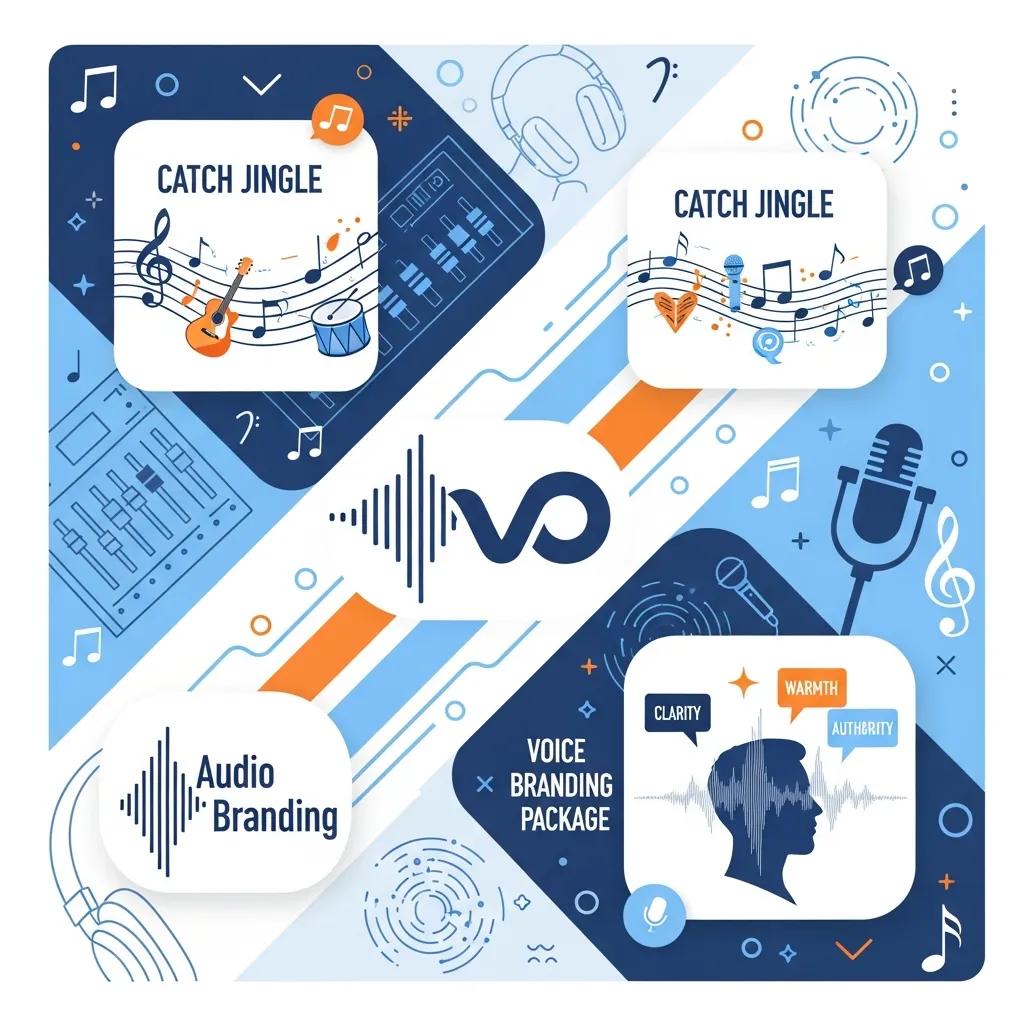
Enterprise audio branding solutions comprise a catalog of scalable assets and production services tailored to brand architecture and distribution requirements. Typical offerings include custom corporate jingles, sonic logos, voice-brand packages, brand soundscapes for physical and digital environments, end-to-end production (arrangement, recording, mixing/mastering), and clear ownership or licensing models that satisfy procurement requirements. Each solution is scoped by use case—broadcast needs masters and stems, IVR needs loopable edits, and voice assistants need short, high‑fidelity sonic logos—so deliverables are defined up front. Below is a short list of common enterprise offerings to help teams prioritize what to brief first.
- Custom Corporate Jingles: Complete short-form music with vocal hooks and lyrical options that embed messaging.
- Sonic Logos: Ultra-short motifs for ads, apps, and voice-enabled devices.
- Voice Branding Packages: Curated talent, read styles, and usage guidelines for a consistent spoken identity.
To help procurement compare service types, the table below summarizes typical deliverables and usage rights across three common enterprise audio products.
This comparison clarifies trade-offs between ownership, flexibility, and the asset formats required for broad deployment.
After reviewing service options, enterprise teams typically want a clear next step: start a discovery session to evaluate needs. A complimentary consultation helps you define scope, deliverables, and licensing preferences so procurement-ready documentation is prepared from the outset.
How Are Custom Corporate Jingles Created to Reflect Brand Identity?
Custom jingles follow a structured creative workflow that ties brand attributes to melody and lyrical choices, producing a singable, memorable asset. The process begins with a brand brief and stakeholder interviews to identify tone, core messages, and use cases; composers then translate those inputs into melodic motifs, harmonic language, and lyric fragments. Production covers arrangement, instrument choices that match brand personality, voice casting for the right timbre, studio recording, and professional mixing and mastering; final deliverables typically include stems, multiple-length edits, and instrumental versions for varied placements. Technical specs—file formats, loudness standards, and stem naming conventions—are set early to prevent implementation friction. Clear production trade-offs speed approvals and simplify integration into campaign workflows.
These creative choices feed directly into sonic logos, which act as condensed identity markers across touchpoints.
What Is Sonic Logo Development and Its Importance for Corporate Identity?
A sonic logo is a compact musical signature—usually 1–3 seconds—that captures brand identity and delivers instant recognition across channels and devices. Sonic logos serve as auditory trademarks, especially valuable in voice-first contexts such as assistants and mobile notifications, where visuals are absent. Development focuses on memorable intervals, distinctive instrumentation, and production clarity so the motif remains recognizable at low bitrates and when layered over other audio. Best practice includes both short and extended variations, as well as localized versions for global markets, to preserve consistency while respecting regional musical norms. Done well, a sonic logo becomes the audio counterpart to a visual logo, reinforcing identity at every touchpoint.
How Does Strategic Sound Design Support Corporate Marketing and B2B Engagement?
Strategic sound design aligns sonic assets with the buyer journey, using audio to support awareness, consideration, and conversion phases across enterprise sales cycles. Sound primes attention in top-of-funnel content like podcasts and webinars, sustains engagement in demos, and reduces drop-off in on-hold or IVR interactions—each phase requires different textures and messaging density. For B2B buyers, whose decisions depend on trust and credibility, voice branding and soundscapes in case studies and executive communications add authority and reduce perceived risk. Practical tactics include placing sonic logos at chapter starts, using theme music for webinar series to build recognition, and applying consistent voice guidelines across sales enablement materials. The next subsection explains how voice selection and soundscapes shape the customer experience design.
To operationalize sound in marketing stacks, teams should implement governance rules, distribution workflows, and a central asset library that maps sonic elements to funnel stages.
What Is the Impact of Voice Branding and Brand Soundscapes on Customer Experience?
Voice branding and brand soundscapes shape customer experience by providing consistent auditory cues that reflect brand personality and interaction context. Voice selection—timbre, articulation, cadence, and locale neutrality—affects perceived trustworthiness and relevance, while soundscapes (ambient layers, transitions, and musical beds) create environments suited to specific interactions, such as in-store experiences or virtual events. Governance documents that define approved voices, scripting conventions, and mix guidelines prevent fragmentation across teams. Implementation checklists should include file-naming conventions, loudness targets, locale variants, and a central repository to ensure proper use. When voice and environment are properly governed and distributed, both CX and internal adoption improve.
Understanding CX effects leads to how audio influences purchase intent and competitive positioning.
How Does Audio Branding Influence Purchase Intent and Competitive Differentiation?
Audio branding influences purchase intent by improving message memorability, increasing ad effectiveness, and creating sensory differentiation in crowded categories. Behavioral mechanisms include affective priming—where music and voice shape mood—and recognition-driven attribution, which raises the likelihood of choosing a familiar brand. To measure causal impact, teams can run A/B tests with and without sonic branding on matched audiences or conduct brand-lift studies during campaign flights to quantify attribution lift and shifts in purchase intent. Distinctive sonic motifs create a defensible sensory signature competitors can’t easily replicate, strengthening long-term differentiation. By tying metrics to commercial KPIs, audio strategies can be linked directly to pipeline and revenue outcomes.
The section below explains the provider advantage when engaging an experienced audio branding partner.
What Is the Cary Reich Advantage in Enterprise-Level Audio Branding?
The Cary Reich advantage comes from a client-focused approach that blends creative craft with enterprise-ready deliverables and flexible ownership models. Cary Reich, The Jingle Writer, brings decades of experience with national brands and a network of recording talent to shape a fresh sonic voice for each project. That experience shortens production timelines: proven processes and established talent relationships reduce onboarding friction and deliver consistent results. We offer flexible licensing and ownership options to meet enterprise legal and procurement needs. Clients can choose negotiated licenses or full ownership based on their rollout strategy. For teams seeking a partner versed in national campaign standards and the mechanics of catchy short-form music, a discovery conversation is the logical next step.
These provider strengths show that long-term national experience reduces risk and aligns better with enterprise programs.
How do decades of National Brand Experience Benefit Large Corporations?
Decades of national brand experience help corporations by providing refined processes, clear creative standards, and talent networks familiar with high-stakes campaign workflows. Experience shortens iteration cycles by using past patterns to move quickly through brief-to-rough workflows, and by building relationships with seasoned voice and session musicians to ensure quality without repeated casting delays. Knowledge of broadcast specs, stem management, and cross-platform encoding reduces technical rework at implementation. For enterprise clients, proven short-form music craft increases the likelihood of creating assets that capture attention and comply with legal and licensing constraints. These advantages produce fewer surprises and more predictable timelines on multi-stakeholder projects.
Why Are Tailored Audio Branding Solutions More Effective Than One-Size-Fits-All?
Tailored audio branding aligns sonic elements with a company’s brand architecture, product lines, and regional differences in ways that off-the-shelf assets cannot. Custom solutions allow purposeful variations—different instrumentations or localized voices—while preserving a central motif, enabling coherent global rollouts that respect local tastes. A governance model with usage rules, approved variants, and a central asset repository maintains consistency at scale. By contrast, templated approaches often produce shallow recognition and can create dissonance across touchpoints or complex sales motions. For enterprise adoption, customization plus robust governance delivers both distinctiveness and operational scalability.
After selecting a partner and approach, procurement teams need a clear project process, which we describe next.
What Is the Process for Successful Enterprise Audio Branding Projects?
A successful enterprise audio branding program follows defined phases: discovery and strategy, creative development, production and approvals, implementation and governance, and ongoing measurement. Each phase includes specific activities and deliverables to make procurement reviews straightforward and reduce scope creep. Clear timelines—briefing and stakeholder alignment in weeks, drafts and approvals over subsequent sprints, final delivery and integration support—help legal and procurement map budgets and milestones. The table below offers a phase-by-phase breakdown with deliverables and typical timelines to set enterprise expectations.
Here is a procurement-friendly phase table detailing key activities and timelines:
This breakdown clarifies expectations and helps procurement evaluate scope, budget, and timeline.
- Align stakeholders and finalize a brand brief that maps messages to channels.
- Approve musical direction and voice options through iterative demos.
- Finalize masters, stems, and technical deliverables; complete a governance handbook.
These steps enable predictable handoffs and a supported rollout across marketing and CX systems; once governance is in place, versioning and updates are managed efficiently. To start a documented enterprise project, schedule a complimentary consultation.
How Do Discovery and Strategy Define Corporate Audio Branding Goals?
Discovery and strategy establish goals by mapping stakeholders, use cases, and KPIs so creative work directly supports measurable business outcomes. Stakeholder interviews reveal differing priorities—marketing seeks recognition, CX wants lower IVR abandonment—so the brief must reconcile and prioritize objectives. Use-case mapping assigns asset types to channels (e.g., sonic logos for voice assistants, extended jingles for TV and podcast ads). KPI alignment translates creative aims into metrics such as recall lift or engagement time and establishes procurement-ready acceptance criteria. A focused discovery phase produces a concise brief and measurement plan to guide creative choices and evaluation.
This explains the value of a structured creative and production workflow, which the next subsection details.
What Are the Steps in Creative Development, Production, and Implementation?
Creative development starts with concept rounds that present multiple motif directions, followed by iterative refinements to composition and arrangement driven by stakeholder feedback. Voice casting and recording logistics run in parallel with arrangement approvals to save time, and sessions deliver isolated stems for reuse. Mixing, mastering, and QA include loudness compliance and platform-specific encoding to ensure consistent playback across digital and broadcast environments. Final deliverables include labeled masters, stems, length variations, localization files, and an implementation guide documenting usage rules and technical specs. Post-delivery support typically covers integration help and a versioning plan for future updates.
With implementation complete, organizations must measure effectiveness, which the final major section addresses.
How Can Corporations Measure the ROI and Effectiveness of Audio Branding?

Measuring audio branding effectiveness means mapping each sonic asset to the KPI it’s intended to influence and using experimental and observational methods to attribute impact. A measurement framework pairs assets (sonic logo, jingle, IVR) with metrics such as recall, ad lift, engagement, and conversion attribution, and recommends A/B testing and brand-lift studies to establish causality. Analytics should combine quantitative signals (listen-through rates, on-hold abandonment, ad attribution) and qualitative feedback (focus groups, listening sessions) to capture nuance. The table below maps common enterprise sonic assets to recommended KPIs so teams can prioritize measurement and align it with commercial objectives.
Below is a KPI mapping table linking audio assets to measurable outcomes:
This mapping provides a practical starting point for enterprises to prioritize measurements that link audio work to business results.
Which Key Performance Indicators Demonstrate Audio Branding Success?
Key indicators for audio branding include brand recall, ad-attribution lift, engagement time with audio/video content, conversion lift in campaign cohorts, and operational metrics such as on-hold abandonment and IVR completion rates. Brand recall is typically measured with pre‑ and post‑exposure surveys; ad-attribution lift comes from randomized A/B experiments; engagement metrics come from analytics platforms that track listen-through and completion. Benchmarks vary by industry, so focus on relative lift—the percentage improvement over baseline—to justify investment to stakeholders. Packaging these KPIs into a concise dashboard simplifies executive reporting and aligns creative teams with commercial goals.
These KPIs become actionable when tied to iterative analytics and experimentation, described next.
How Do Analytics Inform Continuous Improvement of Corporate Sound Identity?
Analytics enable continuous improvement by establishing feedback loops that combine A/B testing, brand studies, and qualitative listening sessions to refine motifs, voice choices, and mix treatments. For example, an A/B test can compare two sonic-logo variants across matched audiences to see which yields higher recall, while qualitative sessions reveal emotional nuances numbers miss. Version control and governance then formalize successful variants into the asset library and update usage guides. Aligning analytics with business KPIs—pipeline influence, ad lift, CX metrics—keeps iteration focused on commercial impact rather than aesthetics. Over time, this disciplined approach converts audio branding into a repeatable strategic capability that scales across product lines and regions.
- Establish a baseline: Capture current recall and engagement metrics before deployment.
- Run controlled tests: Use A/B experiments or region-based rollouts to isolate effects.
- Iterate based on data: Update assets and governance using measured lift and qualitative feedback.
These practices close the measurement loop and make audio branding a continuously improving enterprise asset.
Frequently Asked Questions
What are the key components of a successful audio branding strategy?
A successful audio branding strategy includes a clear understanding of brand identity, target audiences, and market positioning. It involves creating memorable sonic assets—jingles, sonic logos, and voice branding—that resonate with those audiences, supported by a governance model that ensures consistent use across touchpoints. Ongoing measurement and analytics are essential for assessing effectiveness and guiding continuous improvement, ensuring the strategy stays aligned with business objectives.
How can companies ensure consistency in their audio branding across different platforms?
Consistency requires a comprehensive governance framework with usage guidelines, approved voice talent, and defined soundscapes. Communicate the framework to all teams involved in content creation and marketing, and maintain a centralized asset library with clearly labeled files and specifications. Regular training and updates on the brand’s audio identity further reinforce correct application across channels.
What are the common challenges faced during the audio branding process?
Common challenges include aligning diverse stakeholder expectations, managing creative differences, and ensuring technical compatibility across platforms. Integrating audio assets into existing marketing strategies and measuring impact can also be difficult. Clear communication, a structured workflow, and collaborative decision-making help overcome these hurdles. Working with experienced audio-branding partners can streamline the process and reduce friction.
How does cultural context influence audio branding strategies?
Cultural context matters: regions have different musical preferences, linguistic nuances, and emotional associations with sound. Localizing assets—instrumentation, vocal delivery, and lyrical content—improves relevance and resonance. Conduct market research to understand regional differences and adapt sonic branding accordingly, balancing global consistency with local authenticity.
What role does technology play in modern audio branding?
Technology expands what’s possible in audio branding by enabling high-quality production, precise distribution, and detailed measurement. Modern production tools allow sophisticated sound design; digital platforms support targeted distribution; and analytics provide insights into engagement and effectiveness. Voice recognition and voice assistant platforms also create new opportunities for sonic identity when visuals are limited.
How can companies leverage audio branding for customer engagement?
Companies can integrate sonic elements into ads, customer-service interactions, and digital content to create a cohesive brand experience. Well-crafted audio—catchy jingles, reassuring voiceovers, or immersive soundscapes—deepens emotional connections and can improve satisfaction. Using audio in interactive formats like podcasts, webinars, and voice apps encourages deeper engagement and helps build loyalty.
Conclusion
Enterprise audio branding delivers measurable advantages: stronger recognition, deeper emotional connection, and clearer market differentiation. By developing tailored sonic assets and governance, organizations create a cohesive audio identity that travels across touchpoints and markets. To discuss how our enterprise solutions can elevate your corporate sound, schedule a complimentary consultation today. Embrace the strategic power of sound to improve brand experience and drive measurable results.